
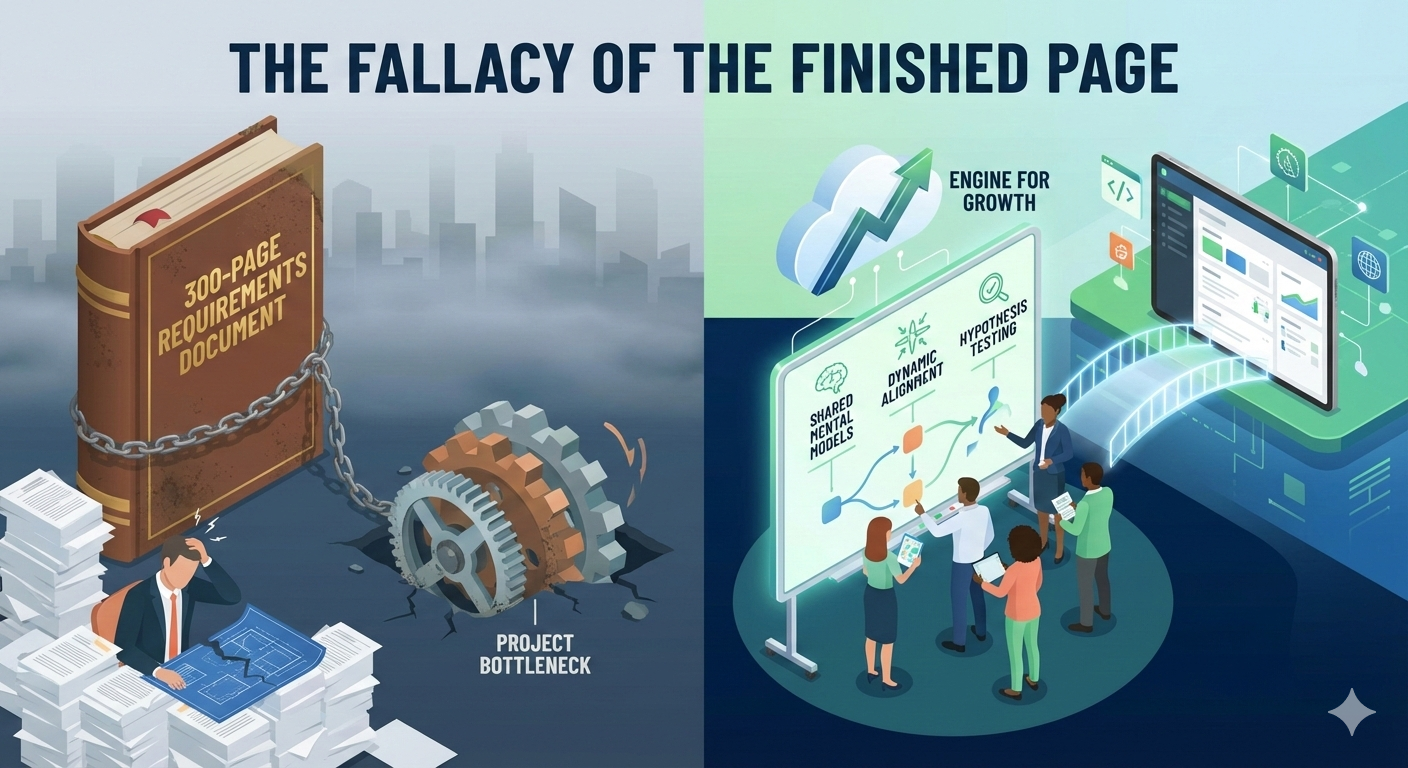
The Fallacy of the Finished Page: Why “Perfect” Requirements are the Leading Indicator of Software Failure
Is your current Shopify setup a engine for growth, or a bottleneck?
I
In the high-stakes environment of enterprise software delivery, the “Requirements Document” is often treated as the ultimate de-risking mechanism. However, empirical evidence suggests a paradoxical correlation: as documentation volume increases, project agility and business alignment inversely decline. This article explores the psychological and systemic drivers behind the documentation obsession and proposes a transition toward Dynamic Alignment—a model that prioritizes shared mental models over static specifications.
The Comfort of False Certainty
The demand for exhaustive, 300-page Business Requirements Documents (BRDs) is rarely driven by technical necessity; it is a risk-mitigation reflex rooted in a desire for certainty in an inherently volatile domain.
- Executive Level: Thick specifications create the illusion that software—a variable-cost endeavor—has been transmuted into a fixed-price asset.
- Engineering Level: Granular tickets offer a “shield of deniability.” If a product fails but the implementation matches the ticket, the engineer is insulated from the fallout.
- Procurement & Legal: Extensive documentation provides a basis for litigation and SLA enforcement, treating creative engineering as a commodity purchase rather than a collaborative evolution.
The Reality: Software is not a static structure like a bridge; it is a high-entropy system. Treating a requirements document as a “blueprint” ignores the fact that in digital ecosystems, the market, the tech stack, and the user behavior shift while the ink is still drying.
Anatomy of the "Document-First" Failure
When the artifact becomes the primary source of truth, three distinct failure patterns emerge that undermine the technical integrity of the project.
-
The Specification-as-Contract Trap
In this scenario, the requirements document becomes a legal boundary rather than a functional guide. When a challenge arises, the internal dialogue shifts from “What is the optimal solution?” to “What did we sign off on?”
- The Compliance Mindset: Teams begin to optimize for “Definition of Done” (DoD) rather than “Definition of Value.”
- The Innovation Tax: Amending a requirement becomes a bureaucratic ordeal involving change-control boards and budget re-allocations. Consequently, teams often proceed with features they know are obsolete because the overhead of change is too high.
-
Feature Fidelity vs. Outcome Success
A project can achieve 100% adherence to a specification and still result in a catastrophic failure of business intent. This is the gap between outputs (the code delivered) and outcomes (the problem solved).
- Case in Point: A legacy enterprise automates a manual approval workflow. The software mirrors the existing paper-process hierarchy perfectly (high fidelity), but the process itself remains inherently inefficient. The document is satisfied; the business is not.
- The Disconnect: Requirements usually capture the how and the what, but they are notoriously poor at preserving the why.
-
Precision vs. Clarity: The Metric Delusion
Teams often confuse precision (numerical targets) with clarity (strategic intent). Requirements documents favor numbers because they feel objective, but precision without context invites "Metric Gaming."
- The Latency Paradox: A requirement specifies a 200ms response time. The team hits this by caching stale data. Technically, the requirement is met, but the utility of the system is compromised.
- The SLA Trap: A system meets a 99.9% uptime target, but the 0.1% downtime occurs during the fiscal year’s peak transaction window. The document records a success; the P&L statement records a disaster.
The Hidden Cost of Frozen Assumptions
The most significant hazard of the “Perfect Document” is the “Hard-Coding” of assumptions. Every requirement is actually a hypothesis: “We believe that if we build Feature X, User Y will achieve Benefit Z.”
When these hypotheses are documented as facts at the project’s inception, they become “frozen.”
- Organizational Shift: The company restructures mid-build.
- Regulatory Volatility: New compliance laws are passed.
- User Reality: Real users interact with the Beta in ways the “Persona” never would.
In a document-heavy culture, responding to these realities is labeled “Scope Creep”—a term that suggests learning is a defect rather than a competitive advantage.
The High-Performance Alternative: Shared Understanding
Elite engineering organizations do not abandon documentation; they demote it. They transition from “Requirements Management” to “Product Discovery,” treating documents as ephemeral inputs to a deeper conversation.
-
Requirements as Hypotheses
Instead of the traditional "The system shall..." syntax, high-performing teams use a "We Believe..." framework. This explicitly acknowledges that a feature is a bet that must be validated through telemetry and user feedback.
-
Just-in-Time (JIT) Documentation
Instead of documenting the entire system upfront, teams document:
- High-level Intent: (The “Why”) during the discovery phase.
Technical Specifics: (The “How”) only when the team is ready to begin the sprint. This prevents “Document Rot,” where a significant percentage of the specification is outdated before the first line of code is committed.
-
Alignment over Artifacts
The most valuable artifact is the shared mental model of the cross-functional team.
Heuristic: “If the requirements document were deleted today, would the team still build the right product?” If the answer is no, the team isn’t aligned; they are simply following a manual.
Strategic Recommendations for Leadership
To move beyond the myth of the perfect document, leadership must change the “Ask” at the start of any initiative. Instead of asking if the requirements are complete, ask:
- Where is the Volatility? Identify the components most likely to change and architect for “easy exit” or modular replacement.
- What are the “Leaps of Faith”? Explicitly list the three assumptions that, if proven wrong, would invalidate the project.
- What is the Decision Path? Define who has the authority to deviate from the plan when the data suggests the plan is wrong.
Conclusion
The perfect requirements document is a ghost of a simpler era. In the modern tech landscape, the goal is not to eliminate change through documentation, but to build a team resilient enough to navigate it. We must value outcomes over outputs and alignment over artifacts.